Android beta setup

From invite to your real dashboard.

Install the private Android beta with Firebase App Tester, connect the Google account that holds your Fitbit history, and confirm OpenFit is reading real data. Most people finish in about five minutes; the first historical sync can continue in the background.

Android 14+Google Health / FitbitRead onlyNo OpenFit account
STEP 01

Accept the Android invitation.

Firebase App Distribution sends the private download link. Open the message on the Android phone where you want to test OpenFit.

Find the message from Firebase

Search Gmail for the exact subject below. Open the invitation on the Android phone you will use for testing.

You’ve been invited to test OpenFit for Android
  1. Tap Get started.
  2. Sign in with the Google account that received the invitation.
  3. Accept the tester invitation once.
  4. Keep using that same account in Firebase App Tester and any Firebase sign-in shown by OpenFit.

Do not forward the invitation. If you accepted it with a different account, stop and contact support before installing; switching accounts later can hide the correct release.

Privacy-safe recreation of the Firebase invitation. Personal email addresses and invitation links are omitted.
STEP 02

Install with Firebase App Tester.

Firebase App Tester is the home for OpenFit beta releases and updates. Use it instead of downloading an APK from a browser or another person.

Install App Tester, then OpenFit

  1. After accepting the invitation, use Firebase’s prompt to install Firebase App Tester. If the prompt is gone, open appdistribution.firebase.google.com on this phone.
  2. Sign into App Tester with the same tester account you used to accept the invitation.
  3. In App Tester, select OpenFit, choose the newest release, and tap Download.
  4. If Android blocks it, allow installs from Firebase App Tester, return to the app, and try again.
  5. Install and open OpenFit. You may initially see incomplete data before connection.

For updates, return to App Tester and use its Download or Update action. Install over the existing app so your on-device OpenFit data stays in place.

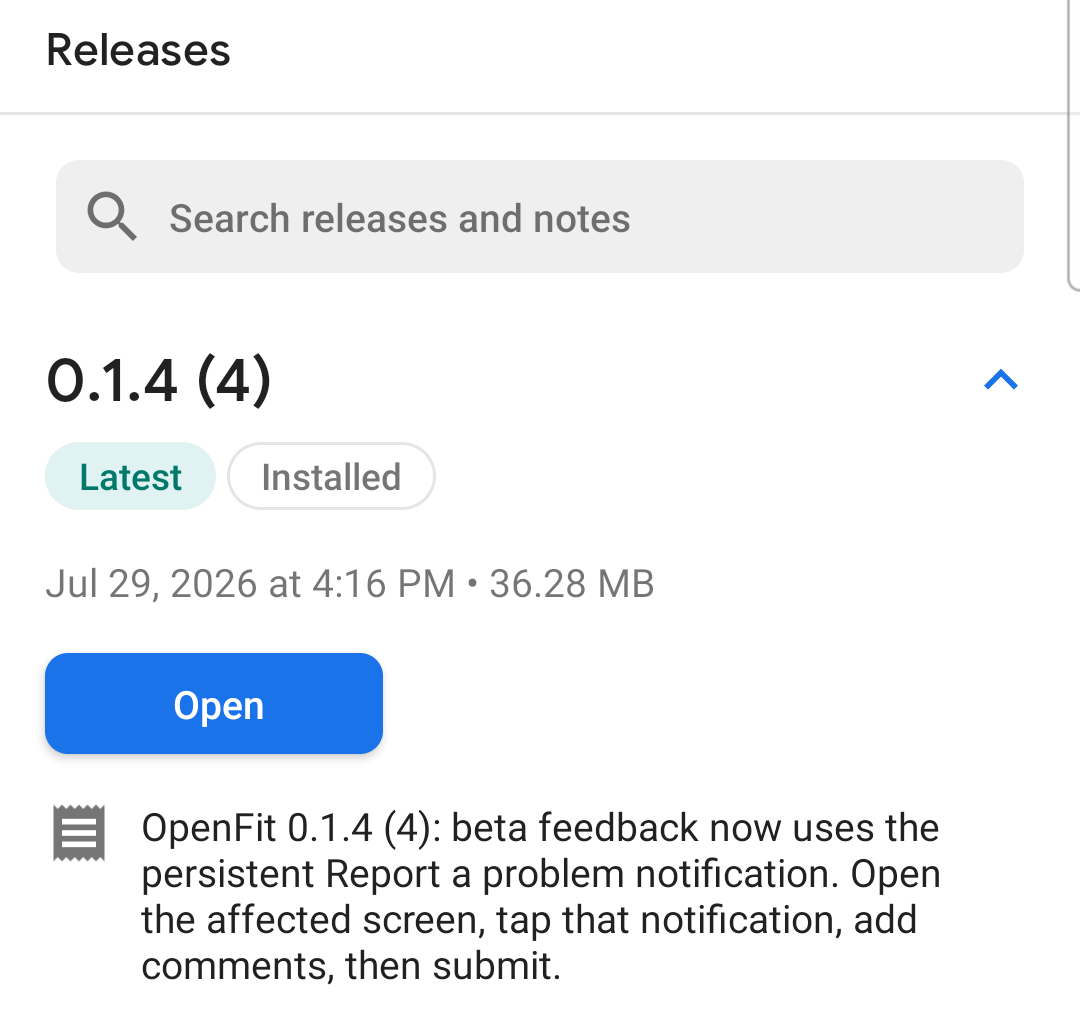
Verify the build after every install. Compare the version shown for the newest release in App Tester with OpenFit → Settings → Legal → Version. The version name and number should match. This guide does not hardcode a release number because the beta changes often.
Firebase App Tester showing OpenFit 0.1.4 (4) as Latest and Installed
The latest installed build is labeled Latest and Installed. When a newer build arrives, use Download or Update here before opening OpenFit.
STEP 03

Connect Google Health directly.

Direct Google Health is OpenFit’s primary Android data source. Health Connect remains available as a local fallback, but most testers should begin here.

Use the account linked to your Fitbit history

  1. In OpenFit, open Settings.
  2. Under Data & Privacy, tap Connect Google Health.
  3. Read OpenFit’s data-use disclosure and continue.
  4. Choose the Google account shown inside your Google Health/Fitbit app.
  5. Approve the requested read-only health permissions.
SettingsData & PrivacyConnect Google Health

During this private beta, that Google email must also be on the project’s test-user list. If Google says access is blocked, see troubleshooting below; repeatedly switching accounts will not fix it.

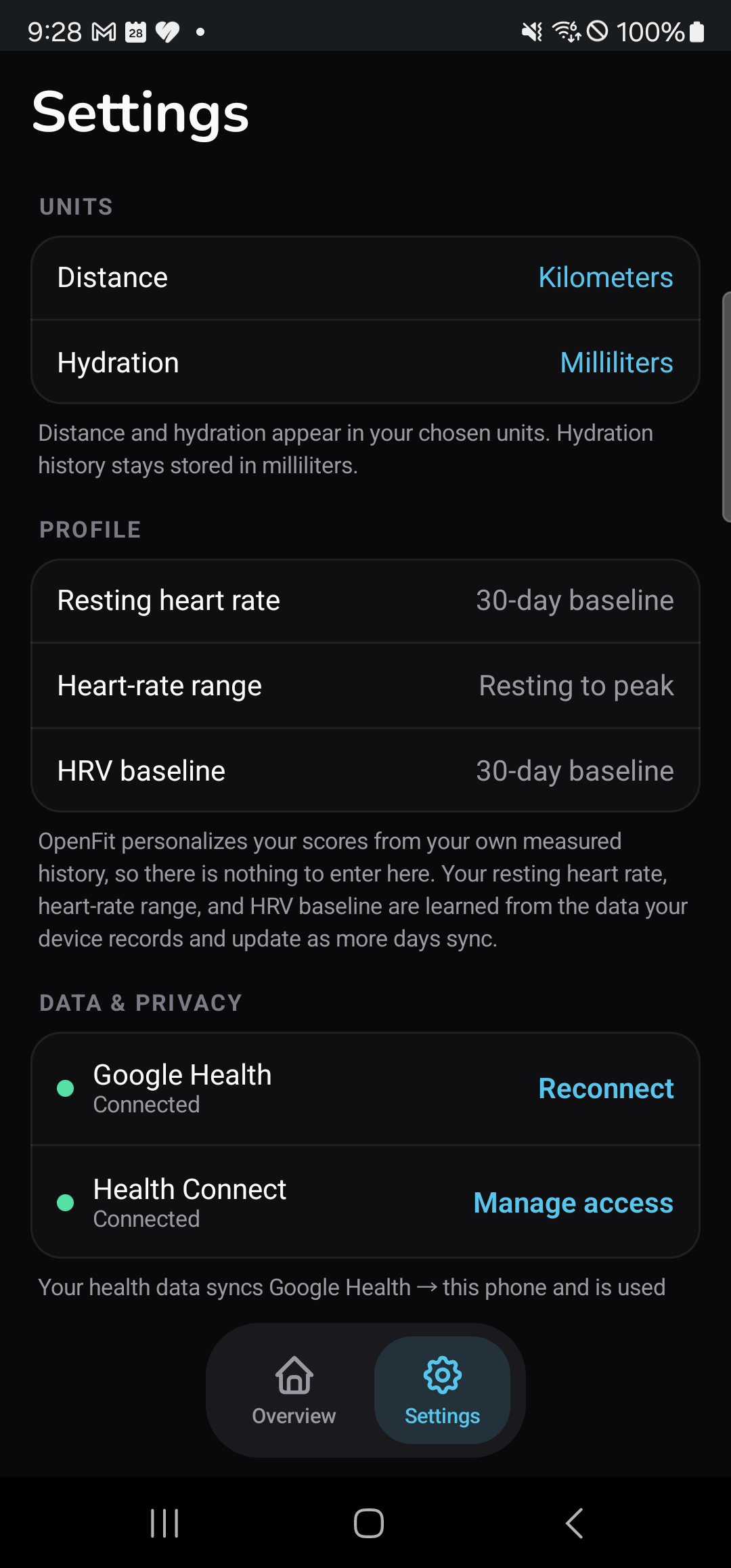
OpenFit Settings showing Google Health connected and Health Connect available
After authorization, Google Health should show Connected. Health Connect may also be connected, but it is not required for the direct Google path.
STEP 04

Let the first sync settle.

OpenFit first paints the newest useful dashboard, then continues historical catch-up for trends and baselines. Keep the app open for the initial foreground pass; older history can safely finish later.

Stay onlineUse a stable connection while Google Health authorizes and returns the first pages. Leave Wi-Fi available for background history.
Keep OpenFit openWait until the loading state becomes the dashboard. A larger Fitbit history can take longer.
Expect honest gapsA broken line or dash means Google did not provide that signal. OpenFit does not stretch data across missing wear time.
Wear data mattersSleep stress requires at least 70% overnight heart-rate coverage. A loose band, charging gap, or sparse night can remain unavailable.

Your first real dashboard

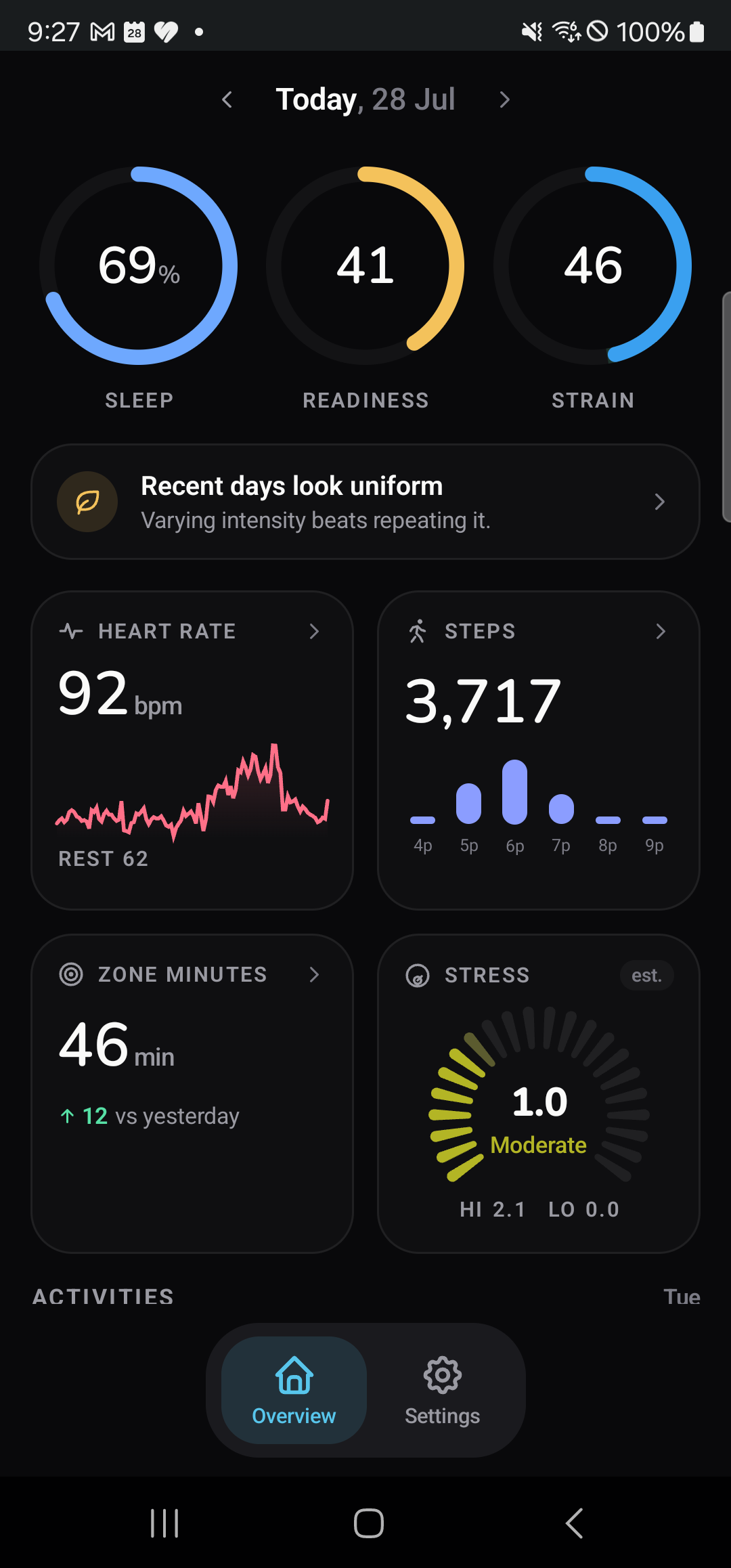
The date header should say today, the rings should be personal, and cards such as heart rate, steps, stress, sleep, and SpO₂ appear when Google supplied them. OpenFit learns 30-day baselines as history fills in.

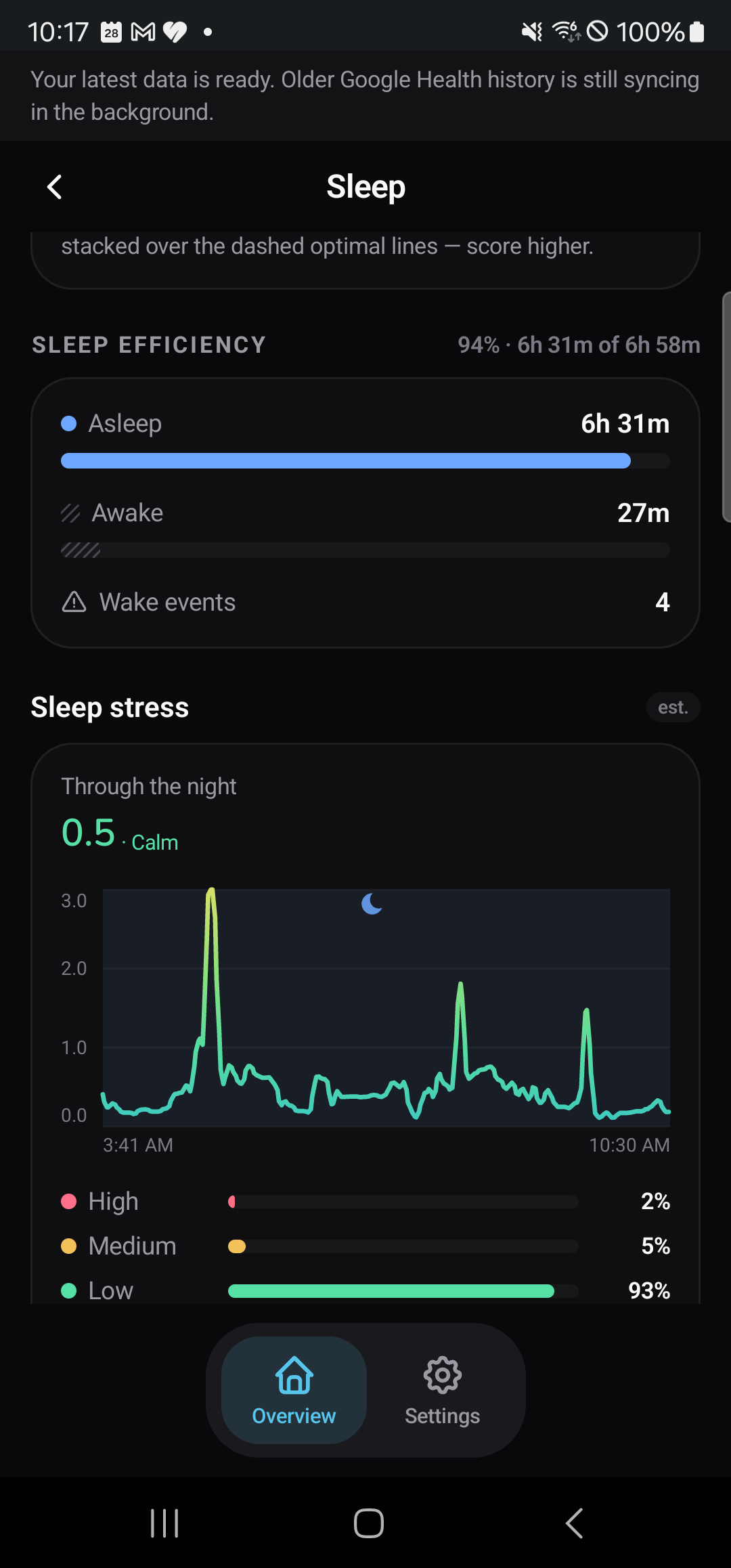
If you see “Your latest data is ready. Older Google Health history is still syncing in the background,” setup succeeded. You can keep using the latest dashboard; leave the phone on Wi-Fi and let OpenFit continue. Closing and reopening the app also triggers a safe recent-data refresh. You do not need to reconnect.

OpenFit Android overview populated with real sleep, readiness, strain, heart rate, steps, zone minutes, and stress data
Real connected data on the Samsung test device. Values will differ by person and time of day.
STEP 05

Verify the build and connection.

Check the installed version first, then use these three screens to distinguish a real-data connection from a sample dashboard or partial fallback.

Build check: Open Settings → Legal → Version and compare both numbers with the newest OpenFit release in Firebase App Tester. If they differ, update from App Tester before troubleshooting data or feedback.

OpenFit Data and Privacy settings with Google Health connected
1. SourceGoogle Health says Connected in Settings.
OpenFit Android overview with real personal health data
2. OverviewToday shows personal rings and metrics, not a sample-data banner.
OpenFit Android sleep page showing a real overnight sleep stress chart, coverage bands, and background-history notice
3. Rich sleepWith enough source coverage, the latest enriched night includes sleep quality, contributors, stages, need, consistency, efficiency, and a real gap-aware sleep-stress trace.

About older nights: OpenFit backfills up to six months of supported Google Health history in bounded background passes. Rich analysis appears per night when that night has the required source signals. A missing score, dash, or broken chart segment is intentional when coverage is insufficient—OpenFit does not substitute sample points or connect across missing wear time.

STEP 06

Report a bug from the screen where it happened.

The Android beta uses a low-priority Firebase notification as its report trigger. There is no Report a Bug button in OpenFit Settings.

Enable the trigger onceOn first beta launch, read “Enable beta bug reports?” and tap Allow, then approve OpenFit notifications.
Stay on the affected screenKeep OpenFit open where the problem is visible. Firebase hides the feedback notification when OpenFit is in the background.
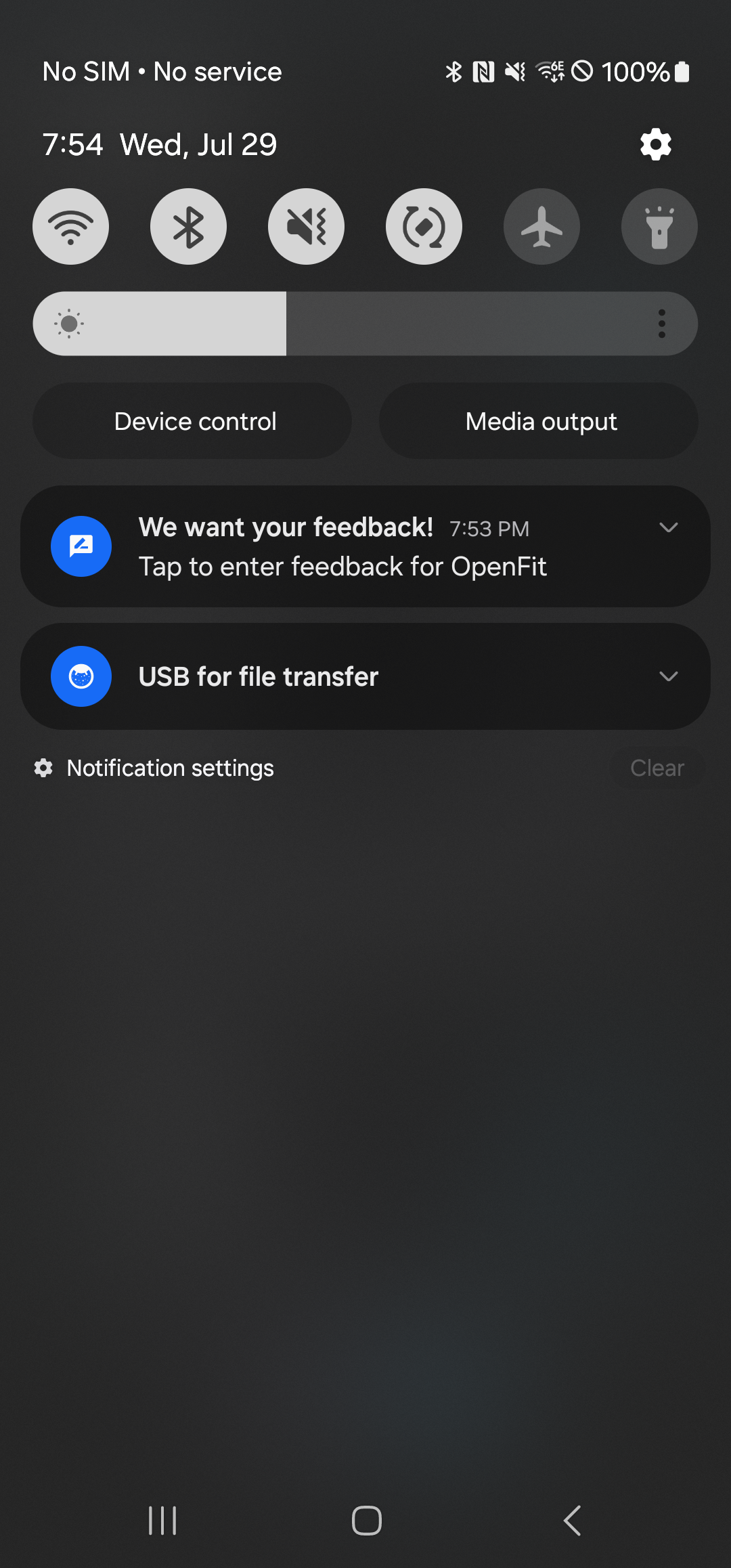
Open the notification shadeTap “We want your feedback!” with the line “Tap to enter feedback for OpenFit.”
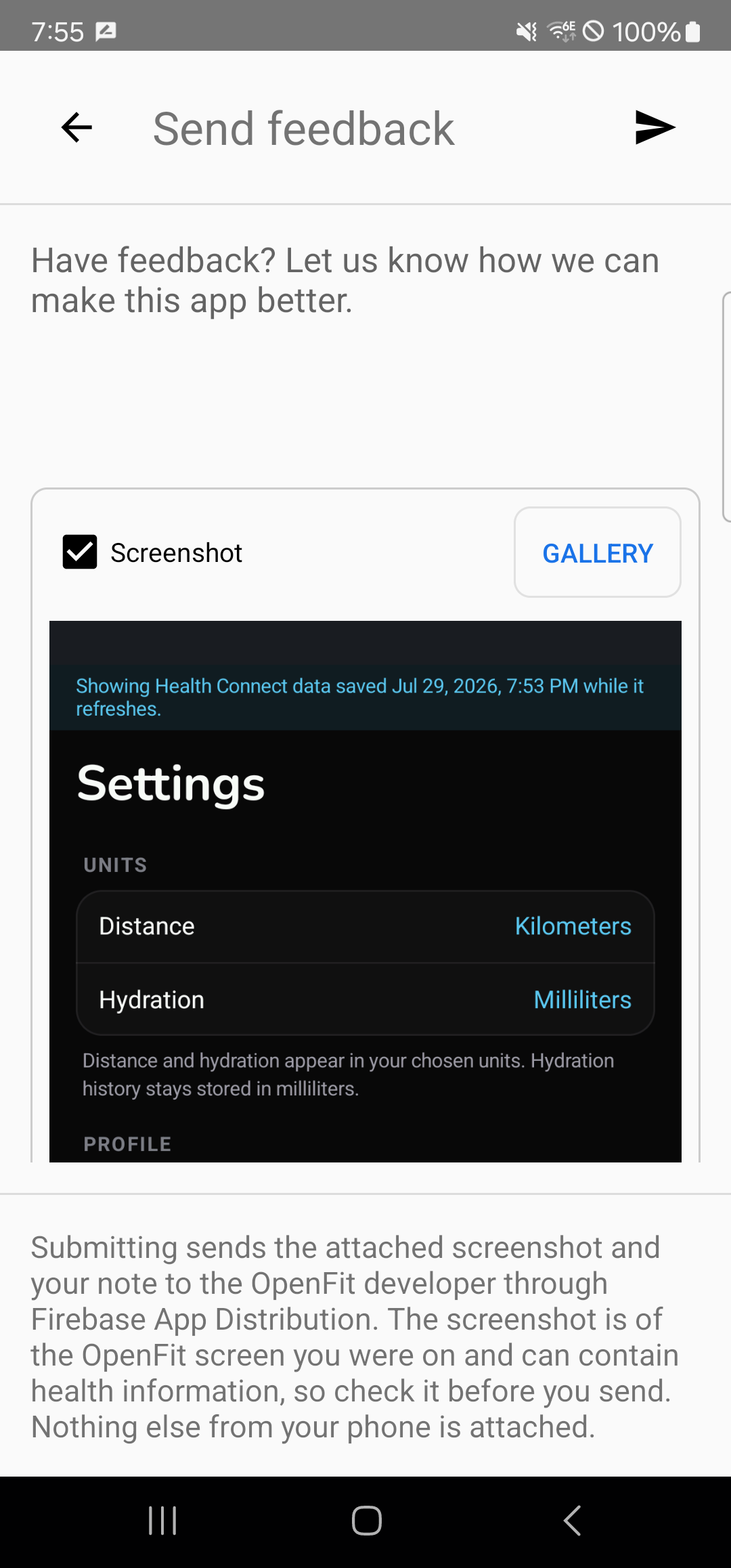
Review before sendingCheck the captured screenshot, uncheck Screenshot if you do not want to attach it, add a clear note, and tap Send.

Tap the Firebase notification

Keep OpenFit in the foreground on the screen where the problem happened, then pull down Android’s notification shade. The feedback trigger is the card shown here—not a button inside OpenFit.

Samsung notification shade with the OpenFit Firebase feedback notification
Keep OpenFit open on the affected screen, then tap this notification.

Review, note, and send

Nothing is uploaded just because the notification exists or you open the form. When you tap Send, Firebase App Distribution sends your note, the attached OpenFit screenshot if selected, and the beta build identity to the OpenFit developer. Beta builds also register an anonymous Firebase install ID so Firebase can match the app and release.

Check the screenshot closely. It can contain health information visible on the OpenFit screen. Hide anything sensitive before capture, choose a cropped screenshot with Gallery, or uncheck Screenshot and send the note alone. Firebase does not attach other photos, files, notifications, passwords, OAuth codes, or a raw health export.

If Firebase asks you to sign in, use the same tester account that accepted the invitation and is signed into Firebase App Tester. Do not use the separate Google Health account unless it is also your tester account.

Firebase App Distribution feedback form with a note field, screenshot preview, Screenshot checkbox, Gallery, and Send controls
Review the preview, uncheck Screenshot or choose a cropped image if needed, add a note, then Send.
HELP

Troubleshooting, in the right order.

Start with the message you actually see. Reinstalling is rarely the first fix and can erase OpenFit’s on-device cache.

Google says “Access blocked” or OpenFit is not verified

The Google account you selected is not enabled on this Android beta client, or you selected a different account from the one we enabled. Reply with the exact Google email linked to your Fitbit/Google Health data. Do not send a password. We will verify the tester list before spending another test-user slot.

The Firebase invitation is missing, expired, or opens the wrong account
  1. Search every inbox for “invited to test OpenFit for Android.”
  2. Open the link on the test phone and accept with the same Google account that received it.
  3. Sign into Firebase App Tester with that same account.
  4. If Firebase says the invitation expired or you are not a tester, email us from the invited address for a fresh enrollment. Do not keep switching accounts.
Android will not install or update OpenFit

Open Firebase App Tester, select the newest OpenFit release, and allow installs from Firebase App Tester when Android prompts. Install over the existing app. If OpenFit Settings still shows an older version than App Tester, send both version numbers to support. Do not uninstall first unless support asks you to.

There is no Report a Bug button

That is expected. Keep OpenFit open on the affected screen, pull down Android’s notification shade, and tap “We want your feedback!” If you never allowed the beta notification, open Android Settings → Apps → OpenFit → Notifications, enable notifications, then close and reopen OpenFit.

Firebase says “Release not found” or asks for another account
  1. Open Firebase App Tester and confirm you are signed in with the account used to accept the invitation.
  2. Confirm App Tester shows the newest OpenFit release.
  3. Compare that release with OpenFit → Settings → Legal → Version and update if they differ.
  4. Return to OpenFit, keep it in the foreground, and try the feedback notification once more.
  5. If it still fails, email support with the exact error, tester email, OpenFit version, phone model, and time. Do not send a password or invitation link.
The feedback form will not send

Stay online and retry once. If the screenshot is sensitive, uncheck it before retrying. If the form still fails, email the note to support with the OpenFit version and exact error; attach a cropped screenshot only if you choose.

OpenFit says older Google Health history is still syncing

This is an informational state, not a connection failure. Your latest dashboard is ready while OpenFit resumes older trend and baseline history in small background passes. Leave the phone on unmetered Wi-Fi with normal battery level. Do not reconnect or reinstall. The notice disappears after supported history reaches the backfill horizon.

Google Health says Connected, but the dashboard is empty or stale
  1. Confirm Google Health/Fitbit itself shows recent sleep, heart rate, and steps for that account.
  2. Keep OpenFit in the foreground on a stable connection for the first pass.
  3. Close and reopen OpenFit once to retry a safe refresh.
  4. In Settings, use Reconnect only if the row says Needs reconnect or Connection failed.
OpenFit asks you to reconnect later

This private Google testing setup can require renewed consent. Go to Settings → Data & Privacy → Reconnect, select the same Google Health account, and approve access again. Your on-device history should remain in place.

You see “No recent Health Connect data”

You are on the fallback path and Health Connect has no useful recent records. Open Google Health → profile picture → Partner apps → Sync your favorite health apps, finish its Health Connect disclosure, and allow the categories you want shared. Then return to OpenFit and try again. Direct Google Health remains the preferred source.

A metric, SpO₂ value, or sleep stress is missing

First check whether Google Health has that value for the same date. OpenFit shows missing data as unavailable rather than inventing a number. Sleep stress requires at least 70% gap-clamped overnight heart-rate coverage plus HRV context; a loose band, charging gap, or sparse night can make it unavailable. If history is still syncing, leave Wi-Fi available and check that night again later.

The app looks connected, but you are not sure the values are yours

Open Settings and confirm Google Health says Connected. Return to Overview, compare today’s steps and recent sleep time with Google Health, and check that no “Sample data” banner is present. If they do not agree after a refresh, send both screenshots to support.
Send a useful beta report.

Use the Firebase feedback notification first. Include the screen, date, what you expected, what happened, your phone and Android version, and the exact OpenFit version shown in Settings. Review the captured screenshot and remove anything you do not want shared.

Good report

“Sleep → Jul 28. Google Health has 6h 31m, but OpenFit shows no sleep stress after reopening. Galaxy S22 Ultra, Android 16, OpenFit version …”

Privacy

Never send a password, OAuth code, invitation token, or raw health export. OpenFit support only needs the tester email and visible symptoms.

If Firebase cannot open or send the form, email OpenFit support →